

Balloons, Invoices and a Beach House in Mexico
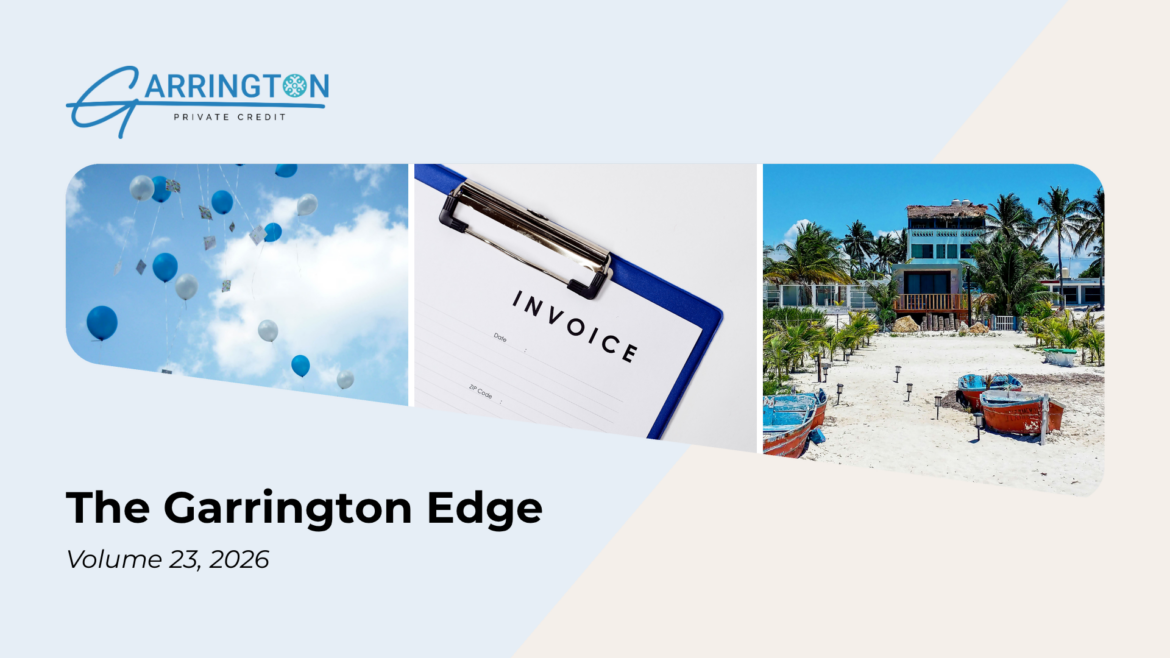
A party supply company, a book of vacation-home mortgages in Mexico, and a factoring client whose customers pay every invoice in full. Three very different borrowers, sitting in the same fund and held to the same rules.
Tammy Kemp, our President and Chief Credit Officer, walked through all three at our Q3 investor call on November 12. One carries a 95% advance rate, one sits at a 41% loan-to-value, and one works out to roughly 57% of appraised value once you do the arithmetic.
These two measures work together to determine how much we lend. The advance rate is the proportion of an asset’s value we will lend against, such as the face value of an invoice or the outstanding balance of a mortgage. Loan-to-value (LTV) compares the amount owed to us with the value of the collateral securing the loan. A lower LTV provides a larger cushion against a decline in collateral value and helps protect our investors’ capital.
Across the Fund, the weighted-average LTV was 61% as at September 30, 2026, within our target range of 50% to 65%. A higher advance rate can still be conservative when the underlying asset is readily collectible over a short period, as our first example shows.
The 95% invoice
Our first example is a factoring client that has been with us for a little over two years, with a $5.3 million facility and about $5 million outstanding.
Every invoice this client issues to its customers gets paid back in full: invoice $100, get paid $100. That record is what supports a 95% advance rate. We validate the payment history before we set the rate, and we make sure the pattern continues for as long as the facility runs.
We do that by speaking directly with our client’s customers before we purchase their invoices, making sure they have received the goods, accepted them and agreed to pay without set-off or deduction. Each customer receives a notice of assignment, and payment for the invoices we purchase comes directly to us. If collection calls are needed, our own team makes them. Notification, verification and direct payment are built into every factoring facility we write. For this client, they sit inside a steady rhythm: invoices issued, verified and purchased, then paid in full on a rotating 60-day cycle, with the next round already under way.
A balloon for every occasion
Our second example is an Asset-Based Lending client that has been with us since 2021. It is a consumer staples company supplying balloons and other party favours to large retailers and dollar stores. Each item is low in cost, and people buy them all year for birthdays, anniversaries and every celebration in between, so the buying pattern holds steady month after month and year after year. Demand builds ahead of marquee occasions such as Valentine’s Day, Mother’s Day, Father’s Day and graduation.
It is not unusual for a client like this to stay with us for years. Seasonal peaks, spikes in demand and periods of growth are exactly what our facilities are structured to support. This client’s approved facility is $7.7 million, and the balance outstanding typically ranges between about $3.5 million and $5.5 million.
The loan-to-value ratio is 41%, well below the Fund’s 61% average. That comes from having every asset class except real estate in the borrowing base: we lend against receivables, inventory and equipment, with a collateral base of about $12.8 million. With that full package, we have several places to recover our advances and a wide cushion beneath the loan.
A beach house in Mexico
Our third example is a Lender Finance facility that has been with us since January 2022. Our client saw a niche opportunity: financing for Canadian and US residents looking to buy an investment property or recreational home in Mexico. The client lends to those buyers, and we lend to the client against that book of mortgages.
The buyers have good credit histories, and every property has an independent appraisal. In Mexico, foreigners are not allowed to own property outright, so an agent holds title on the buyer’s behalf. That arrangement is convenient for us from a realization perspective, and there is a very specific process for foreclosure. We have not had to use it in any instance. Every mortgage has paid as agreed.
Our advance rate is up to 95%, and the economic loan-to-value is much lower. Our client provides a mortgage of up to 60% of a property’s appraised value, and we finance up to 95% of that 60%. That puts our effective loan-to-value at roughly 57% of what the property is worth, again below the Fund’s average. The approved facility is about $15 million, with generally $8 million to $10 million outstanding. Most of these mortgages do not go to term. Borrowers typically keep them for a year or two and then refinance through a personal line of credit or other personal means, so the facility sees regular repayments.
Lending against secured consumer loan books like this one is a meaningful part of our portfolio, primarily in Canada. The word consumer can make investors a little concerned, and Tammy’s response is to focus on the word secured. Each underlying loan has a tangible asset behind it that can be sold for value if the loan fails, and each client’s book is made up of thousands of underlying loans, with default rates monitored very closely.
|
95% Factoring advance rate, backed by direct verification and payment to Garrington |
41% Loan-to-value on the balloon supplier’s facility |
~57% Effective loan-to-value on the Mexico mortgage book |
Three loans, one discipline
Each loan reaches its number a different way. Invoices paid in full on a rotating 60-day cycle, a borrowing base built on three kinds of assets, a mortgage book where every loan sits at no more than 60% of an appraised property. In every case, we know what we are lending against, we control how the cash moves, and we keep the cushion wide enough to protect our investors’ capital.
We would be glad to talk it through:
investors@garringtonprivatecredit.com
Subscribe
Have our blog delivered directly to your inbox: