

When bonds stalled, Garrington Private Credit compounded.
Last week, we discussed how understanding the source of returns may matter more than the asset class label itself.
But correlation and diversification are not theoretical concepts.
They are experienced in real time during periods of market stress.
For many investors, traditional fixed income has historically played a stabilizing role within portfolios. Yet recent years demonstrated that not all fixed income exposures behave the same under pressure
When bonds stalled, Garrington Private Credit compounded.
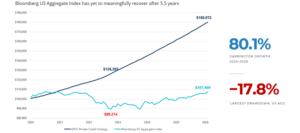
The Bloomberg US Aggregate Bond Index experienced one of the most difficult periods in its history as rising rates repriced duration risk across fixed income markets.
At the same time, strategies driven by shorter-duration cash flows and self-amortizing loan structures behaved differently because the underlying drivers of return were different.
The underlying structure of the exposure ultimately shaped the outcome.
Not all income-oriented investments respond to the same pressures.
Some remain heavily tied to interest rates, duration exposure, or broader market repricing.
Others are driven more directly by contractual cash flows, collateral structures, and the repayment activity of real businesses operating through normal business cycles.
Consistent Compounding vs. High Yield Bonds
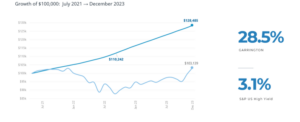
High yield bonds may offer elevated income potential, but they can still remain closely tied to public market sentiment, economic uncertainty, and broader repricing cycles.
Historically, our strategy has behaved differently because the underlying drivers of return have been different.
Rather than relying on long-duration exposure or market repricing, returns have historically been driven by short-duration, self-amortizing loans backed by tangible collateral and structured with capital preservation in mind.
For us, diversification has never simply been about owning another category of credit.
It has been about building exposure to different underlying return drivers that may behave differently across market environments.
Final Thought
Past performance is not indicative of future results.
But market cycles, periods of stress, and changing economic environments are inevitable. That is why diversification remains so important.
Because when markets become more difficult, investors quickly discover whether portfolio exposures are truly differentiated or simply different versions of the same underlying risk.
Subscribe
Have our blog delivered directly to your inbox: