


Where Does Private Credit Fit? Behind the Return
This series set out to answer a practical question for investors: where does private credit fit in a portfolio?
Ask us and the answer comes quickly. We have been lending against assets since 1999, and we live and breathe this work every day. That closeness is the reason for this series. We wanted to step back and write for an investor who is still deciding and set out what we would want them to know.
The first article, Start With Correlation, began with 2022. That year the S&P 500 fell 18.11% and the US Aggregate Bond Index fell 13.01%, so the bonds many portfolios hold for protection fell alongside the stocks. Garrington returned 10.30%. The lesson was that diversification depends on what drives the investments you own. Stocks and bonds can respond to the same pressures, leaving a portfolio more exposed than its mix of holdings suggests. Our returns come mainly from interest and fees on asset-backed loans to private businesses, so they depend on borrowers paying and on the protection built into each loan. Those loans carry their own risks, and their returns follow a different path from public market prices. Garrington’s historical correlation to the S&P 500 has been close to zero.
The second, Follow the Cash, looked at how that return reaches investors. Our short-duration loans are repaid and the capital is lent out again, keeping cash moving through the portfolio. Alongside those repayments, borrowers pay interest and fees, and that income is what the Fund distributes each month. Those distributions are only as strong as the loans behind them, and those loans are our responsibility.
What protects that income?
It comes down to three things: who we lend to, how we structure and approve each loan, and how closely we work with borrowers throughout the relationship.
The first is selectivity. We see between 50 and 150 potential transactions in a typical month and close about four to six. That volume gives us room to decline opportunities that do not meet our standards. We once passed on a specialty distributor with an impressive sales pipeline because its receivables were aging and concentrated in two customers. A few months later, one of those customers filed for creditor protection. A strong pipeline could not fix weak collateral, and we are comfortable missing a loan when the protection is not there.
The second is how we approve each loan, and we follow the same path every time. An originator takes the first look before bringing a business to our underwriters. If we proceed, we issue a terms letter and often go on site. Our diligence looks at the operation, the financials, the quality of the collateral and the legal position of the business and its owners. Depending on the assets, that work includes independent field examinations, inventory counts, customer confirmations and specialist equipment appraisals. We need to understand how the borrower will repay us, and what we could recover if that plan falls short.
Only then does the file go to our Investment Committee, and no facility funds without its approval. Our loans are secured by assets we can value and, if it comes to it, sell – receivables, inventory, equipment, real estate and other lenders’ loan books. We advance less than those assets are worth, which leaves room for uncertainty in what a sale might ultimately recover.
The third is how we manage the loan after it closes. We are partnership lenders. We go into every loan expecting our borrower to succeed, and we stay in their corner as the business changes. Our clients send borrowing base reports every week and financial statements every month. Field examiners return at least once a year and at every renewal, and our account managers are in regular contact with every client. Each facility on our watch list comes before the Investment Committee monthly.
Those touchpoints help us spot changes in collections, collateral or financial performance before they become a missed payment. The relationship matters here, too. Borrowers who trust us are more likely to raise a problem early, giving us more time to assess it and agree on a response.
Sometimes that relationship ends exactly as we hope it will. In August, a US commercial finance company we had financed since December 2018 repaid us in full. Our facilities are written on short terms, so we earned the business again at every renewal. Over nearly eight years, the approved facility grew from roughly US$8 million to US$45 million before the company qualified for bank financing and refinanced. Tammy Kemp, our President and Chief Credit Officer, put it simply: “They had grown to the point where they could access a lower cost of capital, and that is exactly what we want for our borrowers.”
|
For us, earning income and protecting the capital that produces it are part of the same job. |
What the record shows
The record is where an investor can see how that approach has held up. Since our track record began in June 2015, returns have been positive in every calendar year, including the pandemic year of 2020 and the 2022 sell-off in stocks and bonds. Returns in 2026 have also been positive to date.
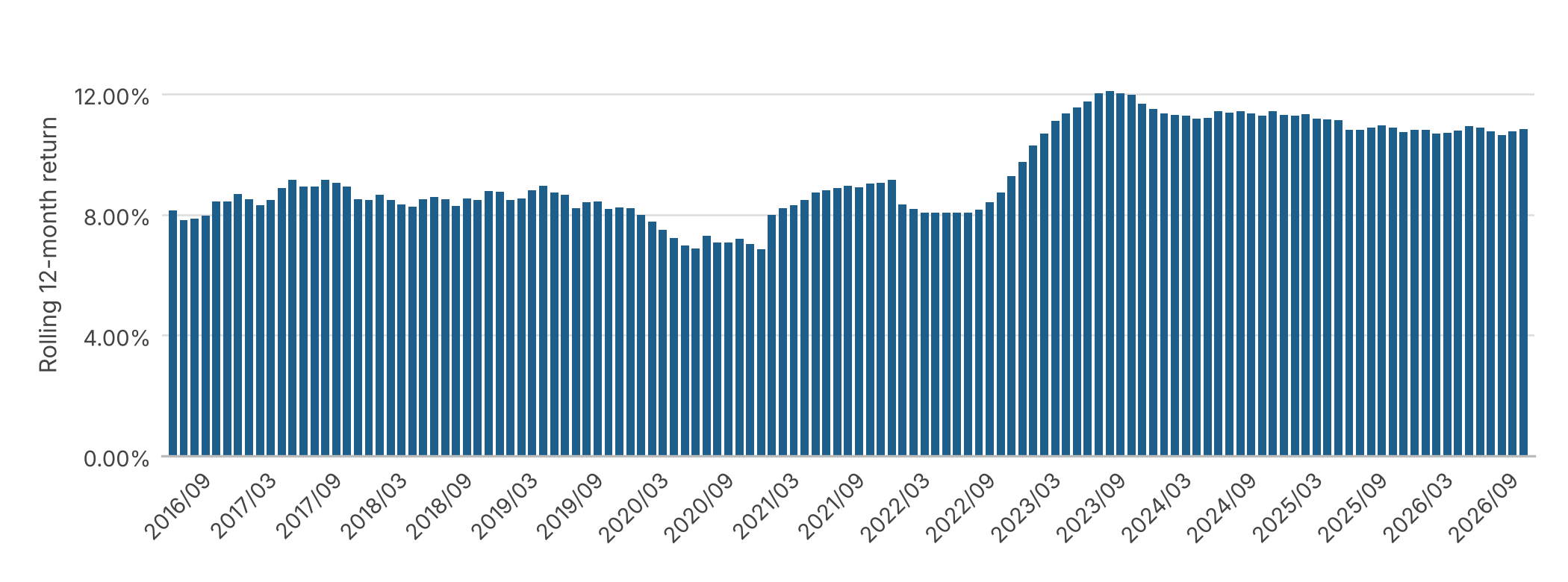
*2015 from June 1; 2026 to September 30. June 2015 to December 2020: Garrington’s asset-weighted performance composite, net of all fees and expenses and adjusted to reflect the fees of the Fund’s Class I units. January 2021 onward: Garrington Private Credit Fund Ltd., Class I units, net of all fees and expenses. Past performance is not indicative of future results.
As at September 30, 2026, the Fund’s Class I units have returned 10.83% over one year, 10.99% annualized over three years and 10.73% annualized over five years, all net of fees and expenses.
How a problem shows up in your return
When a loan runs into trouble, you see it in the Fund’s result early. We take a reserve as soon as we expect a shortfall, often while the work to collect receivables or sell collateral is still under way. Any impairment comes off before the month’s profit is struck, so that month’s result, and the distribution paid from it, already reflect it.
A valuation and impairment committee sets each charge. For loans on our watch list, values are based on what the collateral would actually recover, supported where appropriate by independent appraisals. Others check that work too: an independent valuation review each quarter, field examinations by the Fund’s lending banks, and an annual audit of the financial statements by Deloitte.
We lean conservative. In 2021 and 2025, reserves we had taken in earlier years proved larger than needed and were reversed, which added back to investors’ results.
Built to take a bad year
Our credit impairment rate by year shows how those charges have added up:
| Credit impairment rate | |||
| Year | Rate | Year | Rate |
| 2015 | 0.00% | 2021 | (0.28%) |
| 2016 | 0.60% | 2022 | 0.17% |
| 2017 | 0.12% | 2023 | 0.61% |
| 2018 | 0.46% | 2024 | 0.39% |
| 2019 | 1.58% | 2025 | (0.35%) |
| 2020 | 2.60% | ||
Garrington Private Credit Strategy. Provision for credit losses as a percentage of average quarterly net funds employed, comprising write-offs net of recoveries and amounts provisioned as substantially uncollectable on accounts in workout, as recorded in audited accounting records. Figures in brackets are net recoveries.
Our highest impairment year was 2020, at 2.60%, and the strategy still returned 8.00%. In 2019, the next highest, at 1.58%, it also returned 8.00%.
Part of the reason is breadth, and part is margin. As at September 30, 2026, the Fund held 101 loans, led by Lender Finance at 42.4% and Asset-Based Lending at 36.7%, with 53% in the US and 47% in Canada. Each Lender Finance facility is secured by another lender’s loan book, which is itself made up of many smaller loans. Commercial SME Finance fell to 1.3%, from 14.1% at the end of July, after the long-standing borrower described above refinanced with a bank. The weighted-average loan-to-value ratio was 61%, within our target range of 50 to 70%, and 100% of loans held a first lien. Fund leverage was approximately 0.44x, against a target of 0.5x.
|
10.99% Three-year annualized return, Class I, as at September 30, 2026 |
9 of 11 Years with credit impairment below 1%, 2015 to 2025 |
61% Loan-to-value as at September 30, 2026, against a 50 to 70% target |
When a loan needs a workout
Occasionally, a borrower’s plan falls apart anyway, and our role changes. We stay at the table, working with the owners to understand what can be recovered and how best to protect our investors’ capital.
At the end of 2024, we completed a sizable workout in our Asset-Based Lending book on a loan balance of approximately $3.5 million. By the time the loan was repaid, it had produced an overall yield of 18% for the Fund.
That kind of outcome takes patience and practical work, as in a case we described earlier this year in Volume 18. A borrower had overspent on research and development and on inventory, expecting a large sale that never came. We worked with the owners to wind the business down in an orderly way. Inventory went to existing customers, receivables were collected as product shipped, and the same appraisers who valued the assets at the start helped sell the equipment and what remained.
The relationship still matters through all of this. We need the owners’ knowledge of their business, their customers and their assets to help preserve value. Personal guarantees give them a financial stake in the outcome and help keep everyone working toward the same result.
What we would want you to know
For an investor still deciding where private credit fits, this is what we would want you to take away. The return behind our record is built loan by loan, by people who choose carefully and stay close to the businesses they lend to.
If you would like a closer look, we will share our default, impairment and loan-loss memoranda and walk you through them. You will be speaking with the people who originate, underwrite and manage the loans, so you can ask how the process works and what we have learned along the way.
We have a saying for all of this: we win by not losing. More than twenty-five years in, we have not found a better way to lend.
If you’d like to discuss, please feel free to contact us:
investors@garringtonprivatecredit.com
Subscribe
Have our blog delivered directly to your inbox: